
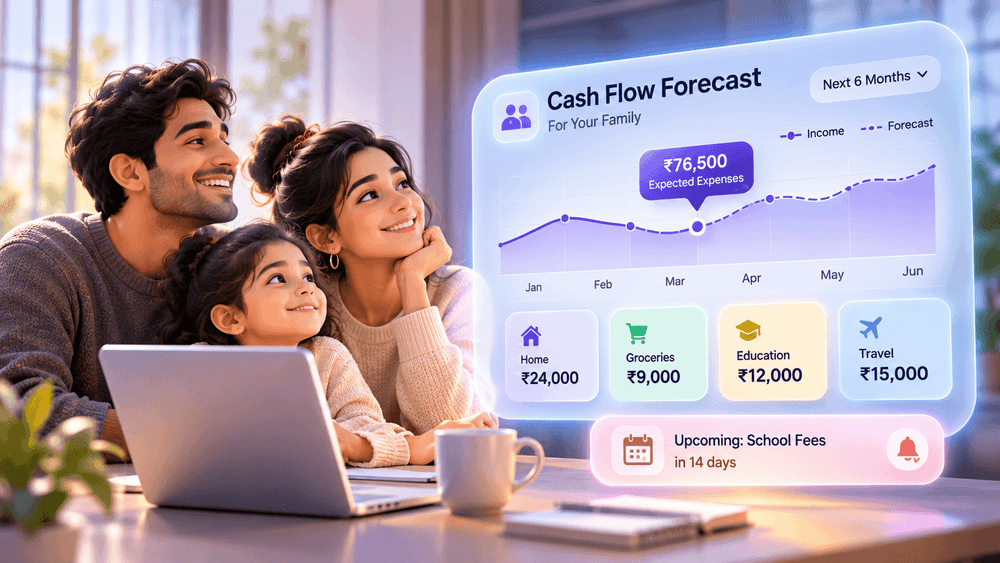
Cash Flow Forecasting for Families: Predict Expenses Before They Happen
Author: Sanjay Gupta
Jun 22, 2026 • 5-minute read
The car insurance renewal. The back-to-school shopping bill. The annual subscription that auto-renews in October. The boiler service you forgot was due.
The car insurance renewal. The back-to-school shopping bill. The annual subscription that auto-renews in October. The boiler service you forgot was due. The birthday weekend that somehow costs four times what you budgeted. None of these are surprises — not really. Every one of them was predictable. But without a system for seeing them coming, they land in your bank account as shocks, creating a cycle of reactive scrambling that's exhausting, expensive, and entirely avoidable.
Cash flow forecasting changes that. It's the difference between running your household finances in real time — responding to what's already happened — and running them three to six months ahead, where you can see what's coming and prepare for it before it arrives. Businesses have used cash flow forecasting as a survival tool for decades. Families who apply the same principle find that financial stress drops, savings increase, and money conversations stop being crisis-driven. Here's how to build a family cash flow forecasting system that actually works — starting this week.
What Is Cash Flow Forecasting for Families?
Family cash flow forecasting is the practice of mapping your expected income and expenses across a future time period — typically three to twelve months — so you can identify potential shortfalls before they happen, prepare for irregular expenses in advance, and make proactive financial decisions rather than reactive ones. It's distinct from a monthly budget. A budget allocates money for the current month. A cash flow forecast looks ahead — identifying the months where expenses will be unusually high, the periods where income may dip, and the gaps between the two that need to be planned for rather than stumbled into.
The core insight is simple but powerful: most financial stress in family households comes not from genuinely unexpected events but from predictable ones that weren't planned for. Annual expenses treated as monthly surprises. Irregular bills that arrive without a dedicated fund. Seasonal spending spikes that hit an already-strained budget. Cash flow forecasting solves all three.
Why Most Family Budgets Miss the Point
Monthly budgeting is better than nothing. But it has a structural limitation that cash flow forecasting fixes.
A monthly budget assumes a relatively even financial landscape — roughly the same income, roughly the same expenses, month after month. Real household finances don't work that way. December costs more than March. September — back-to-school season — drains accounts that were comfortable in August. Car insurance, home insurance, professional memberships, and subscription renewals cluster in specific months and create spikes that a monthly budget never anticipates.
The result is a budget that technically balances on paper in most months but repeatedly fails in the specific months where clustered expenses exceed the monthly allocation. These failures feel like budget breakdowns. They're actually forecasting gaps.
Most people respond by adding buffer to their monthly budget — which works but is inefficient. A cash flow forecast is more precise: it shows you exactly which months need the buffer and by how much, so you're not maintaining unnecessary reserves in months where they aren't needed.
The Two Types of Expenses a Cash Flow Forecast Captures
Before building your forecast, understand the two categories of expenses that make family cash flow irregular — and why both matter.
Irregular but Predictable Expenses
These are the budget killers for most families. They're not monthly recurring items — so they don't appear in a standard monthly budget. But they're entirely predictable because they happen on a known schedule.
Examples: annual insurance renewals, vehicle registration fees, school fees paid termly or annually, holiday travel booked in advance, professional membership renewals, annual subscriptions, home maintenance services (boiler checks, air conditioning servicing, pest control), tax payments, and seasonal celebrations like birthdays, holidays, and anniversaries.
Every one of these can be mapped to a specific month in advance. Every one can be planned for. The reason they feel like surprises is that most households don't have a system for tracking them across a twelve-month horizon.
Variable but Seasonal Expenses
These are categories where spending is genuinely variable month to month but follows a predictable seasonal pattern. Utility bills that spike in winter or summer depending on climate. Back-to-school spending in August and September. Holiday gifts and entertaining in November and December. Summer childcare when school is out. Back-to-school haircuts, uniforms, stationery — all predictable by season even when the exact amount varies.
Seasonal variable expenses are harder to forecast precisely than irregular fixed ones, but they don't need to be precise to be useful. Knowing that December will cost 30–40% more than a typical month — even without knowing the exact number — allows you to prepare. That preparation is the entire point.
How to Build a Family Cash Flow Forecast — Step by Step
This process takes two to three hours the first time. After that, it's a fifteen-minute monthly update.
Step 1 — Gather 3 Months of Actual Spending Data
You can't forecast accurately without a baseline. Before projecting forward, you need to understand what your household actually spends — not what you think it spends.
Pull three months of bank statements and credit card statements. Alternatively, if you've been using a spending tracker , your historical data is already categorised and ready to use. Look for patterns: which months were higher and why? Which categories vary significantly between months? This backward-looking analysis is the foundation of an accurate forward projection.
Step 2 — Map Your Income by Month
List your expected income for each of the next twelve months. For salaried employees, this is straightforward — monthly salary, net of tax, plus any known bonuses or additional income in specific months. For freelancers, contractors, or households with variable income, use a conservative estimate based on your three-month average, flagging the months where income is historically lower.
If your household has two incomes, map both. Note any months where one income may be reduced — planned leave, contract gaps, or seasonal work patterns.
Step 3 — List All Fixed Monthly Expenses
These are the expenses that are consistent every month: rent or mortgage, loan repayments, regular utility direct debits, recurring subscriptions, insurance monthly instalments, and any other fixed contractual costs. These are the easiest to forecast because they don't change.
A bill organiser makes this step considerably faster — all your recurring bills are already listed with due dates and amounts, providing a clean base for your fixed expense projection.
Step 4 — Map All Irregular Annual and Seasonal Expenses
This is the step most families skip — and the one that makes cash flow forecasting genuinely valuable.
Go through the last twelve months of statements and identify every expense that wasn't a regular monthly item. Insurance renewals. Vehicle costs. School fees. Holiday spending. Annual memberships. Home maintenance. Gift spending. Medical bills. Tax payments.
For each one, assign it to the month it typically occurs. Some will be exact — your car insurance renews in April, your home insurance in September. Some will be approximate — holiday spending usually hits August, back-to-school in September. Approximate is fine. The goal is visibility, not perfection.
Step 5 — Estimate Variable Monthly Spending
For your major variable expense categories — food, transport, entertainment, clothing, personal care — use your three-month historical average as the baseline for a typical month, then adjust upward for months where you expect higher spend (December, school holidays, summer) and slightly downward for months where spending typically contracts.
This doesn't need to be precise to the dollar. A range — "December food and entertaining budget: $600–$800" — is entirely adequate for planning purposes.
Step 6 — Build Your 12-Month Cash Flow Map
Now combine everything into a single twelve-month view: income by month, fixed expenses by month, irregular expenses mapped to their actual months, and variable spending estimates by month. The result is a monthly net figure — income minus total expenses — for each month of the year.
This is where the forecast earns its value. You'll see the months where you have comfortable surplus. You'll see the months where expenses cluster and the net figure turns tight — or negative. Those tight months are the ones to plan for, not react to.
Step 7 — Create Funding Plans for Deficit Months
For every month where your forecast shows expenses significantly exceeding income, create a specific funding plan. The most effective approach is sinking funds — allocating a fixed amount each month into a dedicated reserve for a known irregular expense.
For example: if your annual car insurance premium is $1,200 due in April, allocate $100 per month to a car insurance sinking fund from May through March. When April arrives, the money is there. The expense doesn't create a shortfall because it was funded incrementally across eleven months.
Use a goal tracker to manage multiple sinking funds simultaneously — holiday fund, home maintenance reserve, annual insurance fund, back-to-school budget. Each fund has a target, a timeline, and visible progress. The forecast tells you what's coming; the sinking fund system ensures you're ready for it.
The Most Common Irregular Expenses Families Forget to Forecast
After working through your own data, use this checklist to catch the items most commonly missed in family cash flow forecasts.
Annual and semi-annual bills:
Vehicle insurance, home insurance, life insurance premiums, vehicle registration and MOT/inspection, professional or trade memberships, annual streaming and software subscriptions, domain and hosting renewals, dental and optical appointments.
Seasonal and calendar-driven expenses:
Back-to-school clothing and supplies, school trip payments, holiday gifts and entertaining, summer childcare and camp fees, holiday travel and accommodation, seasonal wardrobe updates, year-end charitable giving.
Home and vehicle maintenance:
Boiler or air conditioning service, pest control, gutter cleaning, appliance replacements (budget an annual average even without specific knowledge of when), tyre replacements, vehicle servicing outside regular maintenance schedules.
Life events and social:
Weddings, milestone birthdays, new babies in the family, graduation gifts, housewarming presents. These aren't fully predictable but a reasonable annual allowance based on your social calendar prevents them from being shocks.
Medical and personal:
Annual check-ups and specialist appointments not covered by insurance, prescription renewals, glasses or contact lens replacements, therapy or wellness expenses. Most families who work through this list for the first time find five to ten categories they weren't tracking — representing anywhere from $1,000 to $5,000 in annual spending that was hitting their accounts as reactive surprises.
Family Cash Flow Forecasting With Multiple Household Members
Single-person cash flow forecasting is relatively straightforward. Multi-adult households add a layer of complexity — and a significant opportunity for misalignment.
The most common household cash flow problem isn't one partner overspending or one income dropping. It's asymmetric financial visibility — one person knows the full picture of the household's expenses, income, and upcoming financial commitments; the other is working with an incomplete picture and making spending decisions accordingly.
A family budgeting tool that gives all household members real-time visibility into income, spending, and forecast commitments resolves this immediately. When both partners can see the same financial picture — including the upcoming car insurance renewal, the school fees due next term, and the current balance of the holiday fund — spending decisions are made in context by everyone, not just the person who happens to manage the accounts.
For families with children old enough to understand money, a simplified version of the cash flow forecast is genuinely educational. Showing a teenager that the family plans for the car insurance renewal twelve months in advance, or that the holiday was funded incrementally through a dedicated savings pot, teaches financial planning by demonstration rather than lecture.
How Often Should You Update Your Family Cash Flow Forecast?
A cash flow forecast isn't a document you create once and file. It's a living planning tool that requires regular updates to stay useful.
Monthly update (15 minutes):
After each month closes, compare actual spending against the forecast for that month. Note significant variances — overspends in specific categories, unexpected expenses that weren't captured, income changes. Use this to improve next month's projection.
Quarterly review (45–60 minutes):
Every three months, review the next six months of your forecast. Add any new irregular expenses you've become aware of. Adjust sinking fund contributions if a target has changed. Reassess variable spending estimates based on actual patterns from the past quarter.
Annual rebuild (2–3 hours):
Once per year, rebuild the forecast from scratch using the past twelve months of actual data. This is the most accurate version of your forecast and the one that captures any new annual expenses, changes in income, or shifts in spending patterns.
Your spending reports provide the monthly and quarterly data you need for these updates without manual data gathering — the historical patterns are already visible, categorised, and comparable across time periods.
The Psychological Benefit — Financial Stress Drops When You Can See What's Coming
There's a dimension of cash flow forecasting that pure financial analysis misses: the psychological impact of financial visibility.
Financial stress in households is rarely about the absolute amount of money available. It's about uncertainty — not knowing whether there's enough, not knowing what's coming, making decisions without adequate information. Research on financial wellbeing consistently shows that perceived control over finances matters as much as actual financial position in determining stress levels and relationship satisfaction.
A cash flow forecast provides that control — not by changing your income or reducing your expenses immediately, but by replacing uncertainty with visibility. When you can see that December will be tight but January and February will recover, December feels manageable. When you don't know what December will look like until you're living it, the tightness feels like a crisis.
This isn't trivial. Household financial stress is one of the leading contributors to relationship strain, sleep disruption, and general mental health burden. A system that replaces reactive anxiety with proactive planning has benefits that extend well beyond the spreadsheet.
Getting Started — Your First Cash Flow Forecast This Week
The perfect cash flow forecast is the enemy of a useful one. Don't wait until you have twelve months of perfect data, a complete list of every irregular expense, or the ideal tool configured exactly right.
Start with what you have. Three months of bank statements. A rough list of the annual expenses you can remember. A ballpark estimate of your monthly variable spending. That's enough to build a first draft that's already more useful than a monthly budget alone.
TimelyBills gives you the infrastructure to build and maintain a family cash flow forecast without spreadsheet management — expense tracking that captures your historical patterns, bill organisation that maps your recurring and irregular commitments, goal tracking for sinking funds, and spending reports that make monthly updates a fifteen-minute exercise rather than a financial archaeology project.
The families who take control of their finances don't necessarily earn more. They see more. Start seeing what's coming — and stop being surprised by expenses that were always predictable.
Top 10 FAQs — Cash Flow Forecasting for Families
1. What is the difference between a family budget and a cash flow forecast?
A budget allocates money for the current month based on expected income and expenses. A cash flow forecast projects income and expenses across the next three to twelve months, identifying future shortfalls before they occur. A budget manages the present; a forecast manages the future. Both are more effective when used together.
2. How far ahead should a family cash flow forecast look?
A twelve-month rolling forecast is the most useful horizon for most families — long enough to capture all annual irregular expenses, short enough to project with reasonable accuracy. Some families extend to eighteen or twenty-four months when planning for significant known expenses like university fees, home renovations, or family events.
3. What are sinking funds and how do they relate to cash flow forecasting?
Sinking funds are dedicated savings reserves for specific known future expenses — car insurance, holidays, home maintenance, school fees. Cash flow forecasting identifies which months will have high irregular expenses; sinking funds provide the mechanism to fund those months incrementally rather than all at once. They work together: the forecast tells you what's coming, the sinking fund ensures you're ready.
4. How do I handle variable income in a family cash flow forecast?
Use a conservative income estimate based on your three-month average for planning purposes. Flag the months where income has historically been lower and build your forecast around the conservative scenario. Any income above the conservative estimate becomes available to accelerate savings or top up sinking funds — a pleasant surprise rather than a planning dependency.
5. Can cash flow forecasting help families save for long-term goals?
Directly. Once your forecast shows surplus months — periods where income comfortably exceeds expenses — those surpluses can be deliberately allocated to long-term savings goals rather than absorbed into lifestyle spending. A goal tracker paired with your forecast makes this allocation visible and intentional.
6. What's the most common irregular expense families forget to include in forecasts?
Home and vehicle maintenance. Most families budget for known maintenance appointments but don't allocate for unscheduled repairs — which are statistically predictable even when individually uncertain. Allocating a monthly amount to a home maintenance sinking fund (typically 1–2% of property value annually) prevents repair costs from creating financial shocks.
7. How do I involve my partner in family cash flow forecasting?
Start with a shared financial review session — one hour, both partners present, reviewing the last three months of household spending together. Build the initial forecast together so both partners understand the picture and the methodology. Then use a family budgeting app to maintain shared real-time visibility going forward, rather than relying on one partner to brief the other.
8. Is cash flow forecasting useful for families on a tight budget?
It's arguably most valuable on a tight budget — precisely because there's no margin for unplanned shortfalls. Knowing three months in advance that September will be tight allows you to prepare: reduce discretionary spending in July and August, accelerate a sinking fund contribution, or plan a specific saving strategy. Without the forecast, September's tightness is a crisis. With it, it's a managed challenge.
9. How do spending reports improve cash flow forecast accuracy over time?
Spending reports show your actual historical patterns — which months genuinely cost more, which categories consistently over-run estimates, and how your spending has trended over time. Each month of actual data improves the accuracy of the next month's projection. After six months of tracked data, your forecast becomes significantly more reliable than the initial draft built on estimates.
10. What should I do when actual spending varies significantly from my cash flow forecast?
Treat significant variances as data, not failures. Analyse the cause: was it a genuine unexpected expense (update your annual expense list), a forecast error (adjust your methodology), or a discretionary overspend (address in the budget)? The goal isn't a perfect forecast — it's a progressively more accurate one. Each variance that you understand and incorporate makes the next month's projection more reliable.
Related Resources

Travel Budget Planner 2026: Step-by-Step Guide
Traveling is one of the most rewarding experiences in life. Whether it’s a family vacation, solo adventure, business trip, honeymoon,
Read more
50-30-20 Rule vs Reality in 2026: What Actually Works?
Managing money in 2026 is very different from how it was a few years ago. Rising living costs, subscription overload, inflation, remote
Read more
How to Plan Your Finances for FY 2026–27 (Step-by-Step)
How to Plan Your Finances for FY 2026–27 (Step-by-Step) isn’t about creating a perfect spreadsheet. It’s about building a system you’ll actually follow.
Read more