
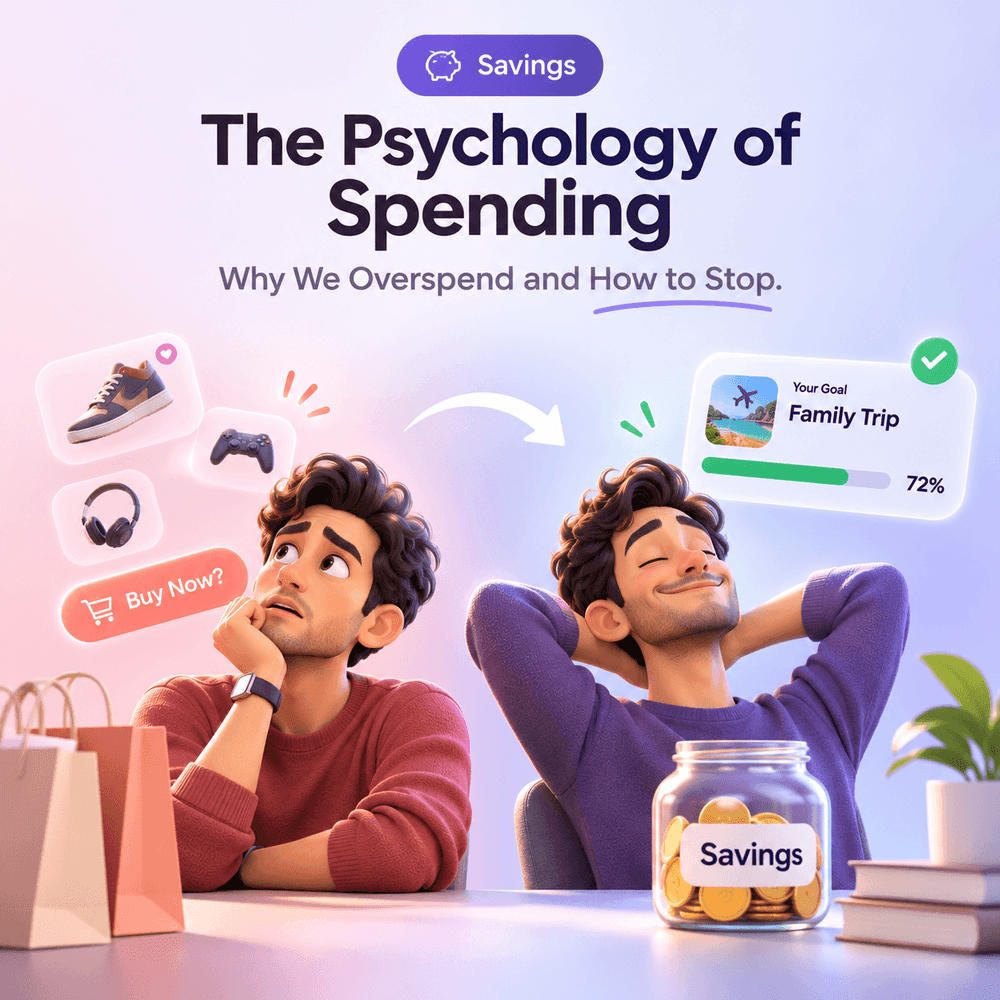
The Psychology of Spending: Why We Overspend and How to Stop
Author: Sanjay Gupta
Jun 15, 2026 • 5-minute read
The Psychology of Spending: Why We Overspend and How to Stop
You knew you didn't need it. You bought it anyway.
Sound familiar? Most people who overspend aren't reckless or irresponsible. They're responding — often without realising it — to psychological forces that are far more powerful than logic or good intentions. The retail industry, the tech platforms, and the financial services sector have all spent decades and billions of dollars understanding exactly how human psychology drives spending decisions. Most individuals haven't had that same education about their own minds.
Here's the thing most financial advice misses: overspending is rarely a maths problem. It's a psychology problem. And the solution isn't a stricter budget or more willpower — it's understanding why your brain makes the decisions it does with money, and building systems that work with your psychology instead of against it.
The Psychology of Spending — A Quick Definition
The psychology of spending refers to the mental, emotional, and cognitive processes that drive purchasing decisions — including the biases, triggers, and emotional states that cause people to spend more than they intend or can afford.
Understanding spending psychology means recognising that most financial decisions aren't fully rational. They're influenced by emotions, social comparisons, cognitive shortcuts, and neurological reward systems that evolved long before money existed. Knowing this doesn't excuse overspending — but it does explain it, which is the first step toward changing it.
The Brain's Role — Why Spending Feels Good
Start here, because this is the foundation everything else builds on. Every time you make a purchase — particularly an unplanned or indulgent one — your brain releases dopamine. The same neurotransmitter associated with anticipation, reward, and pleasure. This isn't metaphorical. Neuroimaging studies consistently show that the anticipation of acquiring something activates the brain's reward circuitry in ways that are measurably similar to other pleasure responses. Here's the part that matters practically: the dopamine hit peaks at anticipation, not at possession. The moment you decide to buy something — or even the moment you add it to a cart online — produces more neurological reward than actually having the item. This is why the pleasure of a purchase fades so quickly. And why the next purchase feels so necessary.
Retail environments — physical and digital — are engineered around this mechanism. Limited-time offers create urgency. One-click purchasing removes friction. Personalised product recommendations arrive precisely when you're bored or stressed. These aren't accidents. They're deliberate triggers designed to activate your reward system before your prefrontal cortex — the rational decision-making region — has time to evaluate whether you actually want or need what's being offered.
Most people think they're making spending decisions. Often, their neurology is making the decisions and their conscious mind is providing the justification afterward.
The Most Powerful Spending Triggers — Recognise Yours
Not everyone overspends for the same reason. Understanding your specific triggers is more useful than generic advice about cutting back. Here are the most common psychological drivers of overspending.
Emotional Spending — Using Purchases to Manage Feelings
Emotional spending is the most widespread and least acknowledged driver of financial problems. Shopping as a response to stress, boredom, loneliness, anxiety, or low mood creates a genuine short-term emotional relief — and a long-term financial problem.
The mechanism is real. Purchasing something provides a sense of control in moments when other aspects of life feel uncontrollable. It creates a brief distraction from uncomfortable emotions. It delivers the dopamine hit described above. And — crucially — it works in the short term, which is why the habit forms and strengthens. The tell is the pattern. If your spending spikes after difficult workdays, social conflicts, or periods of anxiety — that's emotional spending. The purchases themselves are often irrelevant. The function they're serving is emotional regulation.
Social Comparison and Lifestyle Creep
Humans are intensely social animals. We calibrate what's "normal" — in lifestyle, possessions, and spending — based on the people around us. This was adaptive when "the people around us" meant a small community with broadly similar resources. It becomes expensive when "the people around us" includes curated social media feeds of people showcasing the most aspirational version of their lives.
Social comparison spending doesn't feel like keeping up with the Joneses. It feels like maintaining reasonable standards. It feels like you deserve the things other people seem to have. It feels like your current situation is somehow deficient rather than simply different.
Lifestyle creep is the slower version of the same phenomenon — the gradual, often unconscious expansion of spending as income rises, so that higher earnings never actually translate into higher savings.
The Pain of Paying — Why Cashless Spending Feels Free
One of the most well-documented findings in behavioural economics is that paying with cash hurts more than paying with a card. Brain imaging shows measurably more activity in pain-associated neural regions when people pay with cash compared to card or digital payment.
This is called the "pain of paying" — and its reduction through cashless transactions is a significant driver of overspending in modern economies. Tap-to-pay, one-click checkout, and buy-now-pay-later platforms all reduce the psychological friction of spending. Less friction means more spending. The correlation is consistent across studies.
Scarcity and Urgency — The FOMO Effect
"Limited time offer." "Only 3 left in stock." "Sale ends tonight." These phrases activate the same psychological mechanism: loss aversion. Behavioural economics research consistently shows that the pain of losing something is roughly twice as powerful as the pleasure of gaining something of equal value. Scarcity cues reframe a potential purchase as a potential loss — and loss aversion overrides rational cost-benefit analysis in a way that "you might want this" simply doesn't.
The result is purchases made not because the item is genuinely desired but because the perceived window of opportunity is closing. The urgency is real in the moment. The need was manufactured by the framing.
Present Bias — The Future Self Problem
Present bias is the tendency to overweight immediate rewards relative to future ones. When you choose to spend today rather than save for tomorrow, you're not being illogical by your brain's standards — you're following a deeply ingrained cognitive pattern that prioritises certainty and immediacy over future benefit. This is why "just save more" doesn't work as advice. The future version of you who would benefit from savings feels abstract and distant. The present version of you who wants something feels immediate and real. Without systems that make saving automatic and effortless, present bias wins by default.
The Retail Industry Knows Your Psychology Better Than You Do
This section is worth sitting with for a moment.
Every major retailer, e-commerce platform, and financial app has teams of behavioural scientists, UX researchers, and data analysts whose explicit job is to understand and leverage human psychological vulnerabilities to increase spending. They test price anchoring (showing a high original price to make the sale price feel like a win), choice architecture (positioning premium options to make mid-tier options feel like sensible compromises), and social proof (showing how many people bought this item in the last hour).
They're not doing anything illegal. But they are playing a game with asymmetric information — they know your psychology far better than most people know their own. Awareness of these tactics doesn't make you immune, but it does change the nature of the interaction. You're no longer an unwitting participant; you're a conscious one who can recognise the technique being applied.
That recognition — "this limited-time offer is a scarcity trigger designed to activate loss aversion" — creates just enough cognitive distance to allow your rational mind to evaluate the actual decision.
How to Actually Stop Overspending — Strategies That Work With Your Psychology
Generic advice like "make a budget" or "stop impulse buying" doesn't work because it treats overspending as a knowledge problem. You don't need to know that impulse buying is bad. You need systems that change the conditions under which spending decisions happen.
Here's what actually works.
Make Your Spending Visible in Real Time
The most powerful single intervention against overspending is real-time expense visibility. When you can see exactly what you've spent today — not a weekly summary, not a bank statement at month end — spending decisions are made in context rather than in isolation.
A daily coffee that costs $5 feels inconsequential in isolation. Seen against a running daily total of $47 when your daily budget is $50, it registers differently. This is why a spending tracker changes behaviour in ways that end-of-month reviews don't. The feedback loop needs to be tight — same day, ideally same hour — to influence the decision.
Use the 24-Hour Rule for Non-Essential Purchases
For any non-essential purchase above a personal threshold — say $30, $50, or $100 — implement a mandatory 24-hour wait before buying. This single friction-adding intervention neutralises impulse buying more effectively than most other techniques.
The mechanism is straightforward: impulse purchases are driven by emotional state and manufactured urgency, both of which dissipate within 24 hours. If you still want the item tomorrow — with the same intensity and conviction — buy it. Most of the time, you won't.
Build a Budget on Real Data, Not Aspirations
Most budgets fail because they're built on how people wish they spent money, not how they actually do. A budget that allocates $200 to food for someone who genuinely spends $380 doesn't create savings — it creates repeated failure and guilt, which often triggers more emotional spending.
Build your budget from at least one month of tracked actual spending. Identify your real patterns. Then set targets that are challenging but achievable — 10–15% reductions in specific categories, not wholesale lifestyle changes. A budgeting app built on your actual spending data is incomparably more effective than a template.
Name Your Spending Triggers and Plan Responses
Most people track what they spend. Few track why. After a week of expense tracking, review your purchases and annotate each non-essential one with a one-word trigger: bored, stressed, celebratory, social pressure, FOMO. Patterns emerge within days.
Once you know your triggers, you can plan alternative responses. Stress-triggered spending: a specific non-spending stress relief activity you actually enjoy. Boredom spending: a pre-planned free activity. Social pressure spending: a script for declining or suggesting free alternatives.
The preparation is the key. Deciding in the moment of a trigger is hard. Executing a pre-planned response is easy.
Automate Savings Before You Can Spend Them
Present bias — the tendency to spend now rather than save for later — is best beaten by removing the decision entirely. Set up an automatic transfer to savings that happens on payday, before the money is visible in your spending account. You can't spend money you've never seen. This isn't a trick — it's working with your psychology rather than against it. The amount doesn't need to be large to start. It needs to be automatic.
Track your savings progress toward a specific goal using a goal tracker . Visible progress toward a named goal is significantly more motivating than an abstract "save more" intention — and motivation sustains the behaviour through the difficult moments.
Eliminate Late Fees — The Easiest Money You'll Ever Save
Late payment fees are pure waste — money leaving your account for zero value in return, triggered entirely by forgetting rather than spending decisions. They're also a source of low-level financial stress that ironically often triggers more emotional spending.
A bill organiser with automated reminders removes this entirely. Five minutes of setup. No more late fees. No more stress about missed payments. It's the lowest-effort, highest-certainty money saving action most people aren't doing.
Make Family Spending Visible and Shared
Household overspending is often invisible because no one person has a complete picture of what the household is spending. One partner buys groceries; the other orders takeaway; subscriptions accumulate across multiple accounts. The total is only visible at month end — when it's too late to change it.
A family budgeting tool creates shared visibility in real time, aligns the household on spending priorities, and removes the asymmetric information problem that undermines most household budgets. When everyone can see the running total, everyone's spending decisions are made in context.
Review Your Spending Patterns Monthly
Pattern recognition requires data over time. A single month of spending tells you what happened. Three months of spending data tells you why — the recurring patterns, the seasonal spikes, the categories that consistently exceed budget. Monthly spending reports transform your financial data from a record of the past into a predictive tool for the future. When you can see that your entertainment spending spikes every time you're under work pressure, you can plan for it — and intervene before it happens rather than reviewing the damage afterward.
The Mindful Spending Shift — From Restriction to Intention
Here's the contrarian view that most personal finance content misses: the goal isn't to spend as little as possible. It's to spend intentionally — allocating money toward things that genuinely improve your life and redirecting it away from things that don't.
Restriction-based approaches to overspending fail because they create deprivation, which triggers emotional spending as compensation. Intention-based approaches work because they're built on values rather than rules. The question isn't "can I afford this?" It's "does this align with what I actually care about?" Most people who complete a month of careful expense tracking are genuinely surprised — not just by how much they spend on certain things, but by how little satisfaction many of those purchases actually delivered. The coffee, the takeaway, the impulse online order. In the moment, they felt good. In retrospect, they're hard to remember.
Spending that you've consciously chosen — a dinner with someone you love, an experience that genuinely matters to you, an investment in your health or skills — lands differently. It doesn't create buyer's remorse. It doesn't fuel the guilt-spending cycle. It's the financial expression of what you actually value. That's the real goal of understanding spending psychology. Not to spend less. To spend better.
Top 10 FAQs — The Psychology of Spending
1. Why do I keep overspending even when I have a budget?
Budgets fail when they're built on aspirational numbers rather than real spending data, or when they don't address the emotional triggers driving overspending. A budget fixes the allocation problem. It doesn't fix the psychology problem. Both need attention simultaneously.
2. What is emotional spending and how do I recognise it?
Emotional spending is using purchases to manage uncomfortable feelings — stress, boredom, loneliness, anxiety. You recognise it by the pattern: spending that correlates with emotional states rather than genuine needs or planned purchases. Tracking both spending and mood for two weeks makes the pattern unmistakeable.
3. Is impulse buying a psychological disorder?
Occasional impulse buying is a normal human behaviour driven by well-understood psychological mechanisms. Compulsive buying disorder — characterised by persistent, uncontrollable purchasing that causes significant distress or financial harm — is a recognised clinical condition for which professional support is available and effective.
4. Why does paying with a card feel easier than paying with cash?
Cash payment activates pain-associated neural regions more strongly than card or digital payment — the "pain of paying" effect documented in behavioural economics research. This reduced pain makes cashless spending feel easier, which directly increases spending volume. Awareness of this effect is the first step to compensating for it.
5. How does social media affect spending psychology?
Social media creates constant exposure to curated lifestyle aspirations, activating social comparison processes and normalising spending levels that may be far above your own income. It also enables frictionless shopping through integrated commerce features. The combination of aspiration creation and purchase friction reduction makes social media a powerful overspending driver.
6. What is lifestyle creep and how do I stop it?
Lifestyle creep is the gradual increase in spending that accompanies income growth, so that higher earnings never translate into higher savings. You stop it by treating income increases as savings increases first — automatically diverting a portion of every raise to savings before it becomes available to spend — and reviewing your budget deliberately when income changes.
7. Does the 24-hour rule really work for impulse buying?
Yes, consistently. The research on implementation intentions — pre-planned responses to specific situations — shows significant effectiveness for impulse control across multiple domains. Most impulse purchase desire dissipates within hours. The 24-hour rule exploits this directly: if the desire survives a day, it was a genuine want. If it doesn't, it was a trigger response.
8. How do spending reports help with overspending?
Spending reports create pattern visibility that point-in-time tracking doesn't. They reveal which categories consistently over-run, which emotional periods correlate with spending spikes, and which habits are genuinely changing versus which are reverting. A monthly spending report turns your financial history into forward-looking insight.
9. Can understanding spending psychology help me save for long-term goals?
Directly. Present bias — the tendency to prefer immediate over future rewards — is the primary psychological barrier to long-term saving. Understanding it enables you to counter it: automating savings removes the present-versus-future choice entirely. Naming and tracking a specific goal makes the future self feel more real and proximate. Both interventions are grounded in behavioural economics research.
10. What is the single most effective habit change for stopping overspending?
Real-time expense tracking. Not end-of-month reconciliation — same-day, ideally same-hour logging of every purchase. This single habit creates the feedback loop that makes every other financial behaviour change more effective. It's the foundation. Everything else — budgeting, goal setting, trigger management — works better when built on accurate, current spending awareness. Download TimelyBills to build this habit with zero friction.
Related Resources
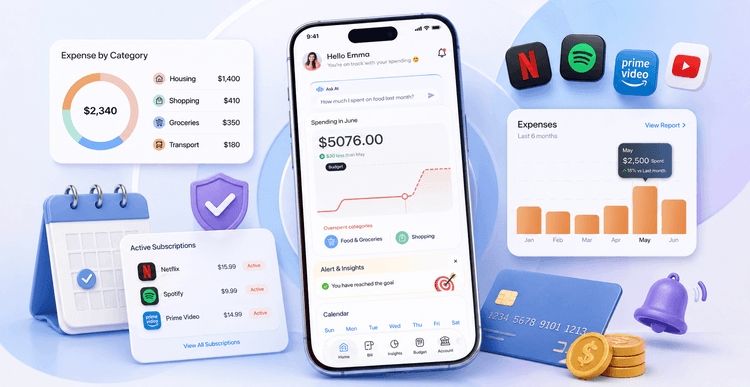
Subscription Fatigue: How to Track and Cancel Unused Subscriptions
In today's digital world, subscriptions have become a part of everyday life. From streaming platforms and fitness apps to cloud storage, productivity tools, meal delivery services, and software memberships,
Read more
30-Day Money Saving Challenge: Build Better Money Habits One Day at a Time
Most people don't fail at saving money because they lack willpower. They fail because they try to change everything at once — cut every expense, build an emergency fund, pay off debt, invest — all in the same week.
Read more
Last-Minute Tax Saving Tips for FY 2026-27
Tax season often arrives faster than expected. Many people spend most of the financial year focusing on income, expenses, bills, and savings goals, only to realize near the
Read more