
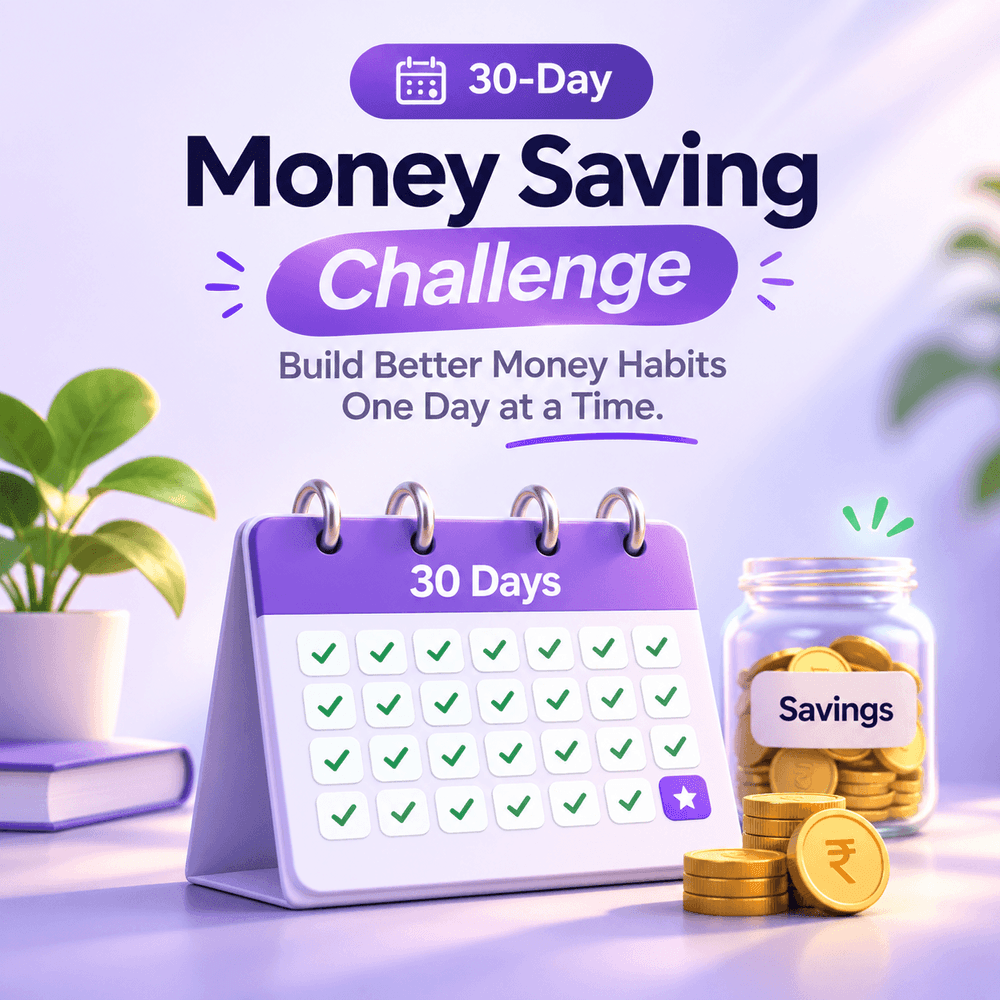
30-Day Money Saving Challenge: Build Better Money Habits One Day at a Time
Author: Sanjay Gupta
Jun 8, 2026 • 5-minute read
30-Day Money Saving Challenge: Build Better Money Habits One Day at a Time
Most people don't fail at saving money because they lack willpower. They fail because they try to change everything at once — cut every expense, build an emergency fund, pay off debt, invest — all in the same week. That approach collapses under its own weight within days.
Here's what actually works: small, specific daily actions that compound into real financial change over 30 days. Not a dramatic lifestyle overhaul. Not a restrictive spending freeze that leaves you miserable by day five. Just a structured challenge that builds momentum, changes habits, and leaves you measurably better off on day 31 than you were on day one.
This 30-day money saving challenge is designed for everyone — whether you're living paycheck to paycheck, managing a family budget, or simply trying to save more consistently without obsessing over spreadsheets. Follow it one day at a time. The results add up faster than you expect.
What Is a 30-Day Money Saving Challenge?
A 30-day money saving challenge is a structured daily framework that guides you through specific financial tasks — tracking expenses, cutting unnecessary costs, setting savings goals, and building smarter money habits — over a single calendar month.
The core idea is behavioural, not mathematical. Most people know they should save more. What stops them isn't knowledge — it's the absence of a daily system. A structured challenge replaces vague intentions with concrete actions, makes progress visible, and builds the kind of financial consistency that outlasts the 30 days themselves.
Done right, a 30-day money saving challenge doesn't just help you save money this month. It rewires how you think about spending, bills, and financial priorities — permanently.
What You'll Need Before Day 1
Before the challenge starts, two minutes of preparation makes the difference between a challenge that fades after a week and one that finishes strong.
A tracking method — you need somewhere to record your spending, savings progress, and daily tasks. A dedicated app like TimelyBills makes this effortless — your expenses, bills, and savings goals all in one place, accessible from your phone. This matters more than it sounds. Challenges that rely on remembering to update a spreadsheet at the end of the day have a much lower completion rate than those with real-time mobile tracking.
Your baseline numbers — what's your current monthly income? What are your fixed monthly expenses (rent, utilities, loan payments, subscriptions)? What do you typically spend on variables (food, transport, entertainment)? You don't need exact figures — a rough picture is enough to start.
One savings goal — pick one thing you're saving toward. An emergency fund, a holiday, a debt payoff, a new laptop. Doesn't matter what. Having a named, specific goal is one of the most powerful predictors of whether a savings challenge succeeds or stalls.
That's it. No complicated setup. Start the challenge the day after you've done these three things.
The 30-Day Money Saving Challenge — Week by Week
Week 1 — Days 1–7: Awareness First
Most people have no clear picture of where their money actually goes. Week one fixes that before trying to change anything.
Day 1 — Track every expense today
Every coffee, every transit fare, every online purchase. Write it down or log it in your spending tracker as it happens. Not at the end of the day — as it happens. The act of recording in real time changes your spending behaviour immediately, even before you've analysed anything.
Day 2 — List all your subscriptions
Streaming services, gym memberships, apps, software, news sites, cloud storage. Most people are paying for three to five subscriptions they've forgotten about. Write every one down with its monthly cost.
Day 3 — Calculate your daily spending average
Take last month's total variable spending (excluding fixed bills) and divide by 30. That's your current daily spend rate. This number will become your benchmark.
Day 4 — Cancel or pause one unused subscription
Look at yesterday's list. Pick the one you use least. Cancel it today. Even AED 25 / $7 / £6 per month is over $80 a year — for something you're not using.
Day 5 — Set up your bill reminders
Late payment fees are pure waste — money leaving your account for no reason. Set up reminders for every bill due this month using a bill organiser so nothing gets missed. Five minutes of setup saves real money every month.
Day 6 — No-spend day
Spend zero on non-essentials today. No takeaway coffee. No impulse purchases. No online browsing with intent to buy. This is harder than it sounds — and more revealing. Notice every moment you'd normally spend without thinking.
Day 7 — Review week one
How much did you spend versus your daily average? Did the no-spend day feel restrictive or manageable? What did you learn about your spending patterns? Write three observations down.
Week 1 goal
Awareness. You're not cutting dramatically yet — you're understanding where the money goes.
Week 2 — Days 8–14: Cut the Obvious Waste
Now that you can see your spending clearly, week two targets the easiest wins — the expenses that cost the most relative to the value they actually add to your life.
Day 8 — Audit your food spending
How much did you spend on dining out, takeaway, and delivery last month? Most people underestimate this by 40%. Calculate the actual number. Then set a realistic lower target for this month.
Day 9 — Plan this week's meals
Meal planning is the single highest-ROI money saving habit most households aren't doing consistently. Plan five dinners, write a grocery list, and stick to it. The savings versus unplanned grocery shopping and impulse takeaway typically run 25–35%.
Day 10 — Find one recurring expense to reduce (not eliminate)
Not cancelling — reducing. Switch to a cheaper phone plan. Negotiate your internet bill. Move to a lower streaming tier. Small reductions on fixed costs compound significantly over 12 months.
Day 11 — Second no-spend day
Back-to-back with a different structure — this time, plan your day around free activities. Cook at home. Walk instead of taking a cab. Use what you already have. Notice whether it feels easier than day six.
Day 12 — Set a weekly spending limit for your top variable category
Whether it's food, entertainment, or shopping — pick your highest variable expense and set a specific weekly cap. Write it down. This single action reduces spending in that category by an average of 20% simply through conscious awareness.
Day 13 — Transfer your first savings amount
Even if it's small — whatever you've saved through this week's actions. Move it to a separate savings account or log it as a savings deposit in your goal tracker . Making the transfer visible and intentional reinforces the habit.
Day 14 — Week two review
Compare this week's spending to week one. Most people see a 15–25% reduction without any dramatic sacrifice. Write down what changed and what still needs attention.
Week 2 goal:
Reduction. You're spending less on the obvious waste, without feeling deprived.
Week 3 — Days 15–21: Build the System
Awareness and reduction are the foundation. Week three builds the system that makes saving automatic rather than effortful.
Day 15 — Create your monthly budget
Not a wish list — a realistic allocation of your actual income across your actual expense categories. Use a budgeting app to set category limits that reflect your spending patterns from weeks one and two. A budget built on real data sticks. A budget built on optimistic estimates fails.
Day 16 — Set up automatic savings
If your bank allows automated transfers, schedule a fixed amount to move to savings on payday — before you see it in your current account. Even a small automatic transfer builds the habit of saving first and spending what remains. Most people do the opposite, and wonder why nothing's left to save.
Day 17 — Identify your spending triggers
Boredom, stress, social pressure, specific apps, certain times of day. Most overspending isn't random — it follows predictable emotional or situational triggers. Write yours down. Awareness of the trigger is the first step to interrupting the pattern.
Day 18 — Third no-spend day
By now, these should feel noticeably easier than day six. If they do, that's a real behaviour shift happening. If they still feel difficult, your spending triggers from yesterday are worth revisiting.
Day 19 — Review your bills for the month
Are all bills paid or scheduled? Any upcoming due dates that need attention? Avoiding late fees is free money — bill management should be a 10-minute monthly exercise, not a crisis every time a due date arrives.
Day 20 — Try a spending fast for one spending category
Choose one non-essential category — clothing, takeaway, entertainment, apps — and spend zero in it for the rest of the challenge. Not forever. Just ten more days. This builds the awareness that most category spending is more optional than it feels.
Day 21 — Week three review
Look at your spending reports for the month so far. Can you see the trend? Is spending tracking lower week over week? What's driving the biggest savings? Visualising progress is more motivating than any external reward.
Week 3 goal:
Systems. Saving is becoming habitual, not heroic.
Week 4 — Days 22–30: Lock in the Habits
The final week is about consolidation — making sure the habits from the first three weeks survive contact with real life and become permanent financial behaviour.
Day 22 — Calculate your projected monthly savings.
Based on what you've tracked so far, what will you save this month compared to last? Seeing the number — even an estimate — is powerful. Write it down and compare it to your savings goal.
Day 23 — Have a no-spend weekend day.
Plan something genuinely enjoyable that costs nothing — a walk, cooking a new recipe at home, a free local event. The point is demonstrating that enjoyment and spending are not the same thing. Most people find this surprisingly easy once they plan for it.
Day 24 — Review your savings goal progress.
How close are you to the goal you set before day one? If you're further than expected, raise the target. If you're behind, identify one specific expense reduction that bridges the gap. Your goal tracker should show this clearly.
Day 25 — Share your progress.
Tell one person — a partner, friend, or family member — what you've achieved this month. Accountability is one of the strongest predictors of sustained financial behaviour change. If you're managing a family budget, this is a good moment to loop in the whole household using a family budgeting tool so everyone's working toward shared goals.
Day 26 — Identify one financial habit to carry forward permanently.
Just one. Meal planning, automatic savings transfer, weekly spending review, no impulse purchases over a set amount. Pick the habit that had the most impact this month and commit to continuing it beyond the challenge.
Day 27 — Final no-spend day.
Fourth and final one. Notice how much easier this is than day six. That's the habit forming.
Day 28 — Update your budget for next month.
Based on everything you've learned this month, set realistic budget limits for next month that are slightly more ambitious than this month. The compounding effect of incremental monthly improvement is enormous over a year.
Day 29 — Calculate your total savings for the month.
Actual number. Compare it to the month before you started the challenge. Write down the difference.
Day 30 — Celebrate and plan forward.
Genuinely acknowledge what you've achieved — changed habits, real savings, a clearer financial picture. Then set your savings challenge for next month. The best outcome of a 30-day challenge isn't the money saved in those 30 days. It's the system you've built to keep saving after it ends.
How Much Can You Realistically Save in 30 Days?
Honest answer: it depends entirely on your starting point and income level. But the pattern is consistent.
People who complete structured saving challenges typically save 15–30% more in their challenge month than in a typical month. For someone spending $3,000 per month on variables, that's $450–$900 in a single month. For a family with higher expenses, the number scales accordingly.
More importantly — the ongoing value is larger than the one-month saving. The spending awareness, the budget system, the automatic transfer, and the habit of tracking all continue working after day 30. Most challenge completers report sustained savings improvements of 10–20% over the following six months.
Common Reasons People Quit Money Saving Challenges (And How to Avoid Them)
Most people who abandon a 30-day challenge do so in week two. The initial motivation has faded, the first no-spend day has happened, and the challenge starts to feel restrictive rather than purposeful.
Trying to be too restrictive too fast
week one should be awareness, not austerity. If you're miserable by day three, you've set the bar too high. Adjust.
No visible progress
this is why tracking matters. If you can't see the savings accumulating, motivation evaporates. Your spending tracker and goal progress should be visible every day.
Treating one slip as failure
a single unplanned purchase doesn't end the challenge. Missing a no-spend day doesn't end the challenge. Continuing after a slip is the skill. Perfectionism is the enemy of financial progress.
Doing it alone
shared challenges have significantly higher completion rates. Find an accountability partner or involve your household in the process.
Tools That Make the 30-Day Challenge Easier
You can run this challenge with a notebook. But the right tools reduce friction dramatically — and lower friction is the difference between a habit that sticks and one that fades.
TimelyBills brings everything this challenge requires into one mobile app: expense tracking with real-time capture, bill reminders that prevent late fees, a budgeting system built on your actual spending data, savings goal tracking with visual progress, spending reports that show your trends at a glance, and family budgeting tools for households working toward shared goals.
Download TimelyBills on Android or iOS and set it up before day one of the challenge. Every daily task in this guide is easier — and more measurable — with the right tool behind it.
Top 10 FAQs — 30-Day Money Saving Challenge
1. How much money should I try to save in the 30-day challenge?
Set a goal based on your income and current spending, not on what sounds impressive. A realistic target is 10–20% of your monthly variable spending. For someone spending $1,500 on variables, that's $150–$300. Achievable goals are completed. Ambitious ones get abandoned.
2. Do I need to give up everything I enjoy during the challenge?
No — and you shouldn't try to. The challenge targets waste and unconscious spending, not intentional enjoyment. You'll do no-spend days and cut unused subscriptions. You won't be told to eliminate every pleasure from your life.
3. What if I miss a day or break a no-spend day?
Continue. Missing one day doesn't invalidate the challenge. The compounding effect of 28 good days outweighs the impact of two imperfect ones. Treat slips as data — what triggered the spending? — not as failures.
4. Can families do this challenge together?
Absolutely, and they should. Household savings challenges have higher success rates when all adults are aligned on goals and spending limits. A family budgeting app makes it easy to share visibility on spending and progress without constant manual updates.
5. What's the difference between a savings challenge and a budget?
A budget is an ongoing monthly financial plan. A savings challenge is a time-limited, habit-building intervention that teaches you the skills and awareness to make better budgeting possible. The challenge creates the habits; the budget maintains them.
6. Is this challenge suitable for people with debt?
Yes — with one adjustment. Your savings goal should include a component allocated to debt repayment. Reducing debt generates a guaranteed "return" equal to your interest rate, which is often the highest-ROI use of saved money for people carrying high-interest debt.
7. How do I track my progress during the challenge?
Daily expense logging, weekly spending totals, and a running savings balance are the three numbers to track. A spending tracker makes this a two-minute daily task rather than a weekly reconciliation exercise.
8. What should I do with the money I save during the challenge?
Transfer it to a separate savings account immediately — not "when the month ends." Moving money out of your current account as soon as it's saved prevents it from being spent. Tie it to the goal you set before day one.
9. Can I repeat the challenge every month?
Yes, and you should raise the bar slightly each time. Month two might target a higher savings percentage, or a new expense category to optimise. The compounding effect of monthly improvement is significant — 10% more savings each month for six months produces results most people wouldn't believe are achievable from a standing start.
10. What's the single most important habit to build during the 30-day challenge?
Daily expense tracking. Everything else — budgeting, goal-setting, bill management — is more effective when it's built on accurate, real-time data about where your money actually goes. Start there, and the rest follows.
Related Resources
Subscription Fatigue: How to Track and Cancel Unused Subscriptions
In today's digital world, subscriptions have become a part of everyday life. From streaming platforms and fitness apps to cloud storage, productivity tools, meal delivery services, and software memberships,
Read more
The Psychology of Spending: Why We Overspend and How to Stop
Sound familiar? Most people who overspend aren't reckless or irresponsible. They're responding — often without realising it — to psychological forces that are
Read more
Last-Minute Tax Saving Tips for FY 2026-27
Tax season often arrives faster than expected. Many people spend most of the financial year focusing on income, expenses, bills, and savings goals, only to realize near the
Read more