
How to Track UPI & Cash Expenses in One Place
Nikita Roy
30, March, 2026 1 min read
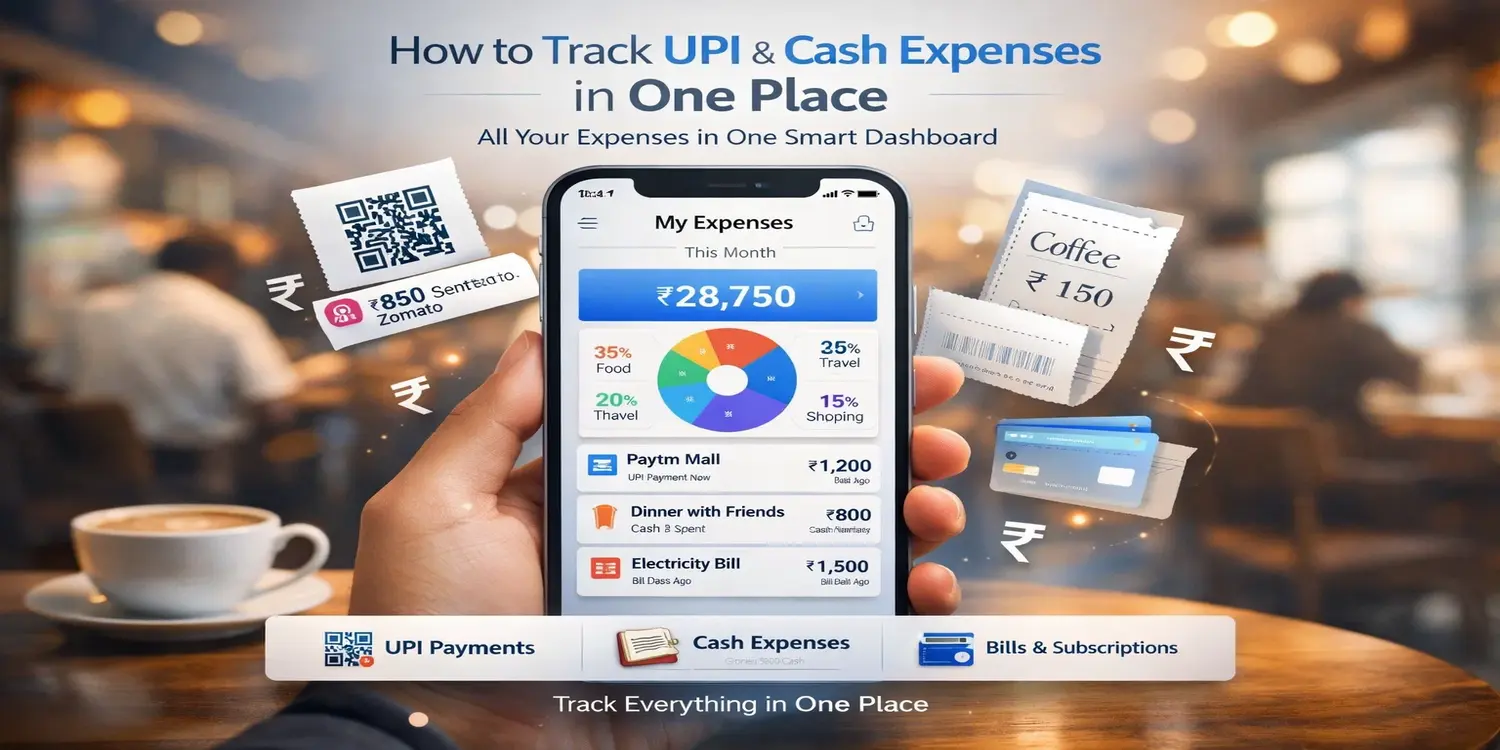
How to track UPI & cash expenses in one place sounds simple, but in reality, most people struggle to do it consistently.
You check your UPI apps. You scroll through your bank transactions. Everything looks fine until the end of the month arrives.
Then suddenly you wonder, “Where did my money go?”
Cash disappears without a trace. UPI transactions are scattered across multiple apps. And tracking? You probably tried it once and gave up.
This is not a discipline issue. It is a system issue.
In this guide, you will learn a practical, realistic system to track both UPI and cash expenses in one place without confusion.
What Does It Mean to Track UPI & Cash Expenses in One Place?
Tracking UPI and cash expenses in one place means using a single system where all your spending, whether digital or physical, is recorded, categorized, and reviewed regularly. This helps you understand spending habits, control unnecessary expenses, and improve financial decisions.
Why Most People Fail to Track Expenses
Here is something people rarely talk about.
Most people do not fail because they lack interest. They fail because the system does not match their daily routine.
Think about it:
- UPI is spread across multiple apps
- Cash has no record
- Tracking feels like extra effort
Most people start tracking for a few days and then stop. Not because they are careless, but because the process feels complicated.
A common real-world pattern is this: people track expenses for three to five days, then skip one day, and eventually quit altogether.
The Real Problem: UPI and Cash Are Separate
UPI is fragmented
You may use different apps such as Google Pay, PhonePe, or Paytm. Each one shows its own transaction history, but there is no single combined view.
Cash is invisible
Cash does not leave any trail. There are no alerts, no reminders, and no history unless you manually record it.
No unified system
You are effectively managing money in multiple places without a single source of truth. That is where the confusion begins.
A Simple System That Actually Works
Instead of complex methods, focus on a simple and consistent system.
Step 1: Use one platform for everything
You need one place where both UPI and cash expenses are tracked together.
A tool like TimelyBills helps bring everything into one system, so you are not switching between apps or guessing your spending.
Step 2: Log cash immediately
This is the most important habit.
As soon as you spend cash, record it within a few seconds. If you delay, you are likely to forget. This is not a personal weakness. It is how human memory works.
Step 3: Keep categories simple
Avoid creating too many categories. That makes tracking harder.
Stick to basic groups such as:
- Food
- Transport
- Bills
- Personal
This gives enough clarity without adding complexity.
Step 4: Review weekly, not daily
Daily analysis is not necessary and often leads to burnout.
Instead, spend ten minutes once a week reviewing:
- Where your money went
- Which expenses were unnecessary
- This keeps the process sustainable.
Step 5: Set flexible limits
You do not need strict budgets at the beginning.
For example:
- Food: around a fixed daily range
- Travel: within a comfortable limit
- These are not restrictions but awareness markers.
Best Way to Track UPI and Cash Together
In theory, you can use notebooks or spreadsheets. In practice, most people do not continue using them.
Mobile-based tracking works better because it fits naturally into daily life.
With TimelyBills, you can:
- Record daily expenses quickly
- Categorize spending
- View monthly summaries
- Monitor budget patterns
You can also explore features like a budgeting app or a detailed spending tracker
A Different Perspective Most People Miss
Many believe that automatic tracking is the best approach.
However, manual tracking can be more effective at the beginning.
When you enter each expense yourself:
- You become more aware
- You remember your spending
- You naturally reduce unnecessary purchases
Awareness is what drives change, not automation alone.
A 30-Day Expense Tracking Plan
If you want to build a lasting habit, follow this simple structure.
Week 1: Awareness
Track every expense without judging it.
Week 2: Observation
Identify patterns and unnecessary spending.
Week 3: Adjustment
Reduce avoidable expenses by a reasonable percentage.
Week 4: Optimization
Refine your spending habits and build consistency.
By the end of this process, you will clearly understand your financial behavior.
Managing Family and Shared Expenses
Expense tracking becomes more important when multiple people are involved.
Using features like family budgeting and bill organizer
you can:
- Track shared expenses
- Manage household bills
- Avoid confusion in payments
Understanding Your Spending Through Reports
Tracking alone is not enough. You also need to understand your data.
With detailed reports
you can:
- Analyze spending trends
- Identify unnecessary expenses
- Make better financial decisions
Goal-Based Expense Tracking
If you have financial goals, tracking becomes even more useful. With a goal tracker
you can plan for:
- Savings targets
- Emergency funds
- Personal goals
Tracking combined with goal setting creates a structured financial approach.
Why This Matters Globally
Whether you are in India, the United States, or Europe, the situation is similar.
Money is spent in multiple forms such as cash, digital payments, or cards. However, most people do not track everything in one place.
This creates confusion and reduces control over finances.
Future of Expense Tracking
The next few years will bring:
- AI-based expense insights
- Smart alerts for overspending
- Automated categorization
Platforms like TimelyBills are already evolving in this direction.
Common Mistakes to Avoid
- Ignoring small daily expenses
- Tracking only digital payments
- Skipping entries for a few days
- Using overly complex systems
Keeping things simple is what makes tracking sustainable.
You do not always need to increase your income to improve your financial situation. In many cases, better visibility into your spending is enough.
Tracking UPI and cash expenses in one place gives you that clarity. Once you understand your spending patterns, making better decisions becomes easier.
Get Started
If you want a simple way to begin, you can use TimelyBills to track your expenses consistently.
FAQs
How can I track both UPI and cash expenses easily?
Use a single expense tracking system where you log both digital and cash transactions regularly.
Do I need to track expenses every day?
Yes, daily tracking helps maintain accuracy and builds awareness of spending habits.
What is the easiest way to stay consistent?
Keep the system simple and record expenses immediately after spending.
Can I manage family expenses using one app?
Yes, many expense tracking tools offer features for managing shared and family expenses.
How quickly will I see results?
Most people notice improved clarity within one week, while consistent improvement happens over a month.

Download the app and get started on your money saving journey




© Copyrights 2026 TimelyBills. All rights reserved.