
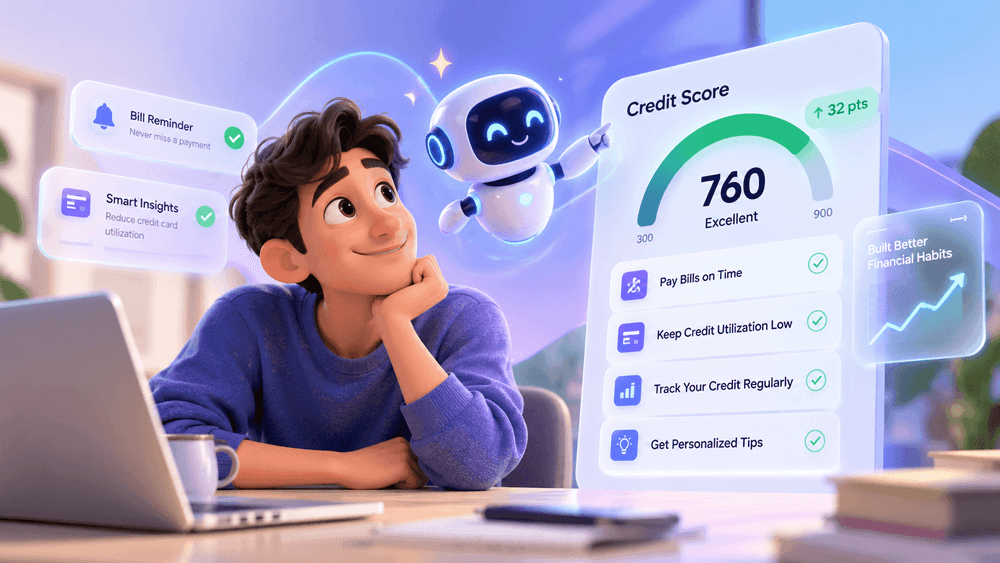
How AI Can Help You Manage Your Credit Score in 2026
Author: Sanjay Gupta
Jul 13, 2026 • 5-minute read
AI helps you track credit habits, spot risks, and make smarter decisions to improve your credit score.
I’m deliberately making this different from TimelyBills’ existing broad article “How AI is Changing Personal Finance in 2026”. That article already covers AI budgeting, expense tracking, bill reminders, savings, fraud detection and general AI finance trends. [Best Money Management Apps](https://www.timelybills.app/blog/how-ai-is-changing-personal-finance
The new article will focus specifically on AI + credit health + practical actions, which gives it a distinct search intent and reduces cannibalization.
How AI Can Help You Manage Your Credit Score in 2026
Your credit score can change because of small financial decisions that are easy to miss.
A high credit-card balance, a late payment, a new account, or even a change in your overall credit usage can affect your credit profile. The problem is that most people only check their credit score occasionally—usually when they are about to apply for a loan or credit card.
AI is changing that approach in 2026.
Instead of simply showing you a credit score, AI-powered financial tools can help you understand spending patterns, monitor credit-related behavior, identify potential problems and turn financial information into practical next steps.
But there is an important distinction: AI can help you manage your credit more intelligently, but it cannot magically increase your credit score. Your actual financial behavior still matters most.
Quick Answer: Can AI Help Improve Your Credit Score?
Yes, AI can help you manage the behaviors that influence your credit score. It can analyze spending patterns, monitor credit utilization, remind you about upcoming payments, identify unusual changes and explain potential risks.
However, AI does not directly “boost” a credit score. Paying bills on time, keeping credit balances under control, avoiding unnecessary applications and maintaining healthy credit habits are still the foundation of good credit.
The real advantage of AI is turning financial information into timely, personalized actions.
What Is AI-Powered Credit Management?
AI-powered credit management uses artificial intelligence and financial data to help users understand and manage their credit behavior.
A traditional credit dashboard might tell you:
Your credit score is 742.
An intelligent system should go one step further:
Your credit-card utilization increased this month. Your balances are approaching a level that may negatively affect your credit profile. Consider reducing the outstanding balance before the next reporting cycle.
That difference matters.
AI can potentially connect information from spending, bills, credit accounts and financial patterns to identify trends that are difficult to notice manually.
AI-powered credit management can help with:
- Credit utilization monitoring
- Payment reminders
- Spending analysis
- Debt tracking
- Credit-card monitoring
- Unusual transaction detection
- Financial behavior analysis
- Personalized financial insights
- Credit-related alerts
- Identifying potential problem areas
The goal isn't to replace financial judgment. It is to help you notice important information earlier.
Why Credit Management Is Becoming More Important in 2026
Credit monitoring is moving from something people do only before borrowing money to a more regular financial habit.
In India, TransUnion CIBIL reported in March 2026 that 183 million consumers were self-monitoring their CIBIL Score, with first-time monitoring consumers growing 27% year over year as of December 2025. The report also found that 45% of monitoring consumers improved their CIBIL Score within six months of monitoring. That reflects a broader shift.
People are becoming more proactive about their credit health.
At the same time, lenders are increasingly using machine learning and AI in credit decisioning. Experian reported in 2026 that lenders using machine learning in India were seeing higher approval rates in some lending categories and improvements in bad-debt management.
This doesn't mean consumers need to become data scientists. It means understanding your own financial behavior is becoming increasingly valuable.
7 Ways AI Can Help You Manage Your Credit Score
1. AI Can Monitor Credit Utilization
Credit utilization is one of the most important areas to watch when managing credit cards. It represents how much of your available revolving credit you are using. For example:
Total Credit Limit Outstanding Balance Utilization $10,000 $1,000 10% $10,000 $2,500 25% $10,000 $5,000 50% $10,000 $8,000 80%
Lower utilization is generally better for credit health. The CFPB notes that experts commonly advise keeping credit use at no more than 30% of the total credit limit, while some people aim even lower.
AI can make this easier to monitor.
Instead of checking several credit-card statements manually, an intelligent financial tool can potentially identify when balances are increasing and alert you before the situation becomes a problem.
Here's the part many people miss:
You don't necessarily have to wait until your credit score falls before taking action. Monitoring the behavior that can influence your score is more useful than reacting to the score after the damage appears.
2. AI Can Help You Avoid Missed Payments
Payment history is one of the most important components of maintaining strong credit.
A forgotten credit-card payment can lead to fees, interest and potential credit consequences.
AI-powered financial tools can help by:
- Tracking payment due dates
- Sending reminders
- Monitoring recurring bills
- Identifying upcoming obligations
- Alerting you when a payment is approaching
- Helping organize multiple credit-card payments
The CFPB recommends paying bills on time and notes that automatic payments or electronic reminders can help consumers avoid missed payments. This is where AI doesn't need to be complicated.
Sometimes the most useful financial intelligence is simply:
“Your payment is due in three days.” A timely reminder can be more valuable than a sophisticated financial prediction.
3. AI Can Identify Spending Patterns
Most people know their credit-card balance.
Fewer people know exactly why it keeps increasing. AI can analyze spending patterns and group transactions into categories such as:
- Groceries
- Restaurants
- Shopping
- Travel
- Entertainment
- Subscriptions
- Utilities
- Transportation
Over time, patterns become easier to identify. For example:
You may think your credit-card problem is caused by one expensive purchase. AI analysis could reveal something different:
Five smaller categories are consistently pushing your monthly spending above your planned budget.
That's a more useful insight.
A good credit strategy starts before debt becomes a problem.
If spending consistently exceeds available cash flow, the credit card becomes a temporary solution for a permanent budget problem.
AI can help make that pattern visible.
4. AI Can Detect Unusual Financial Behavior
Another useful application of AI is identifying spending behavior that doesn't look normal.
For example:
- An unusually large transaction
- A sudden increase in online purchases
- A new recurring payment
- Spending in an unfamiliar category
- Multiple transactions in a short period
AI systems can compare new activity against historical patterns and flag unusual behavior.
That doesn't automatically mean fraud.
An unusual transaction could simply be a holiday purchase or an annual insurance payment.
The value is in getting the alert quickly enough to investigate.
5. AI Can Help You Understand Why Your Credit Profile Changed
Credit scores can be confusing.
You may make what feels like a responsible financial decision and still see a change.
Possible factors can include:
- Payment history
- Credit utilization
- Number of credit accounts
- Length of credit history
- New credit applications
- Changes in outstanding balances
- Other information contained in your credit profile
The CFPB notes that several factors can influence credit scores, including how many credit accounts you have, how close you are to your credit limits and whether payments have been late.
An AI assistant can help translate complicated financial information into simpler explanations.
Instead of showing you a collection of numbers, it could help answer questions such as:
Why did my credit score change? Which balance should I focus on first? Is my credit utilization increasing? What financial behavior should I monitor this month? That makes financial information easier to act on.
6. AI Can Help You Prioritize Credit-Related Actions
This is where AI can become genuinely useful.
Most people don't need 25 pieces of financial advice.
They need to know: What should I do first? Imagine someone has:
- Three credit cards
- Two personal loans
- Several recurring bills
- A high utilization ratio
- One upcoming payment A traditional dashboard might display all of that information. An intelligent system can help organize priorities. For example: Possible priority order
- Avoid a missed payment
- Review the highest credit utilization
- Reduce unnecessary recurring expenses
- Review new credit applications
- Create a realistic debt-reduction plan The exact priorities will depend on the person's financial situation. That's why AI should be viewed as a decision-support tool, not a replacement for financial judgment.
7. AI Can Turn Credit Monitoring Into a Habit
This might be the biggest benefit of all.
People often check their credit score only when they need something. They may check it before:
- Applying for a home loan
- Applying for a personal loan
- Getting a new credit card
- Financing a vehicle
- Refinancing existing debt But financial health works better when monitored regularly.
AI can make monitoring less demanding by providing:
- Automatic alerts
- Spending summaries
- Credit-related notifications
- Trend analysis
- Personalized reminders
- Periodic financial reports The goal is simple:
Move from reactive credit management to proactive credit management.
AI Credit Management vs Traditional Credit Monitoring
What's actually different? Traditional Approach AI-Assisted Approach Check credit score occasionally Monitor patterns continuously Review statements manually Analyze spending patterns React after problems appear Flag potential issues earlier Generic advice More personalized insights Multiple dashboards More consolidated information Manual reminders Automated alerts Static information Trend-based analysis
AI isn't automatically better in every situation.
A simple spreadsheet may be enough for someone with one credit card and a predictable income.
But managing five cards, multiple loans and dozens of recurring expenses is a different story.
The more complicated your financial life becomes, the more valuable automation can become.
Can AI Actually Increase Your Credit Score?
Not directly.
This is an important distinction.
AI cannot simply send a request to a credit bureau and increase your score.
Your credit score reflects information about your credit behavior and profile.
What AI can do is help you manage the behaviors that may influence your credit health. For example:
AI reminder → payment made on time → fewer missed payments AI utilization alert → balance reduced → healthier credit utilization AI spending insight → unnecessary spending reduced → more cash available for debt repayment AI financial report → problem identified earlier → corrective action taken
The AI is the support system.
Your financial behavior is still the driver.
What AI Cannot Do for Your Credit Score Let's be realistic. AI has limitations. It cannot guarantee:
- A specific credit score
- Loan approval
- A particular interest rate
- A fixed number of points gained
- Removal of accurate negative information
- Instant credit repair Be particularly cautious about any service promising to “hack” or instantly increase your credit score.
The CFPB states that accurate negative information cannot simply be removed by paying a credit-repair company, and rebuilding credit takes time and responsible credit management.
AI should help you understand your finances—not encourage unrealistic expectations.
Should You Trust AI With Financial Information?
This is one of the most important questions in 2026.
AI can be powerful, but financial data is sensitive.
Before using any AI-powered finance application, check:
- What information does it collect?
- Why does it need the information?
- How is financial data stored?
- Is data encrypted?
- Can you delete your data?
- What permissions does the application request?
- Does it clearly explain how your information is used?
- Does it distinguish financial education from financial advice?
Don't upload sensitive financial documents into an unknown AI chatbot simply because it promises a quick answer.
Convenience should never come before data security.
AI Financial Advice Still Needs Human Judgment
Here's the contrarian point:
More AI doesn't automatically mean better financial decisions.
An AI system may identify that you spend $800 a month on restaurants. But it doesn't automatically understand your complete situation. Perhaps you're traveling for work. Perhaps you regularly pay for meals for your family. Perhaps the spending is temporary. The numbers need context. Recent financial commentary has also emphasized this limitation: AI can be useful for budgeting, organizing and explaining financial concepts, but users should be cautious about treating AI output as personalized professional financial advice. So use AI for:
Analysis + organization + reminders + pattern recognition
Use human judgment for:
Major financial decisions + complex debt situations + investments + legal/tax matters
How to Use AI to Manage Your Credit Score: A Simple 6-Step Process
You don't need to completely change your financial life. Start with this routine.
Step 1: Know Your Current Credit Position
Review your credit score, credit accounts, balances and payment history.
Step 2: Monitor Credit Utilization
Track how much of your available credit you're using.
Step 3: Automate Payment Reminders
Don't rely on memory.
Set reminders before every credit-card and loan due date.
Step 4: Review Spending Patterns
Look for categories that consistently push your credit-card balance higher.
Step 5: Act on the Biggest Problem First
Don't try to fix everything at once.
Prioritize the issue with the greatest potential financial impact.
Step 6: Review Your Progress Monthly
Look at:
- Spending
- Credit utilization
- Payments
- Outstanding balances
- New credit activity
- Financial goals Then adjust your plan.
How TimelyBills Can Support Smarter Credit Management
Credit management doesn't happen in isolation. Your credit-card payments are connected to your bills, spending, budget and overall cash flow.
That's why organizing these areas together can make financial management easier. TimelyBills provides tools for organizing bills, tracking expenses, budgeting and managing financial information. Its existing credit-focused content also covers using credit cards wisely, improving credit scores, maximizing rewards and identifying when a credit-card upgrade may make sense.
You can explore the existing guides on using credit cards wisely , improving your credit score and maximizing credit-card rewards .
The broader idea is simple:
When your bills, spending and credit information are organized, you can make better decisions with less manual effort.
What Will AI Credit Management Look Like in 2027 and Beyond?
The next phase of financial AI will likely move beyond dashboards. Instead of simply telling you what happened, financial systems will increasingly focus on:
Predictive insights
“Based on your current spending, you may exceed your monthly budget.”
Personalized alerts
“Your credit utilization is higher than usual this month.”
Conversational finance
“Why is my credit-card balance higher this month?”
Scenario analysis
“What could happen if I pay an additional $300 toward this balance?”
Proactive financial coaching
“You have three upcoming payments. Your current cash flow may be tight next week.”
This is the direction the industry is moving toward: from financial tracking to financial intelligence.
Research and industry reporting in India during 2026 also point toward AI becoming an intelligence layer across digital financial infrastructure, while new consumer tools are increasingly using AI for credit-health guidance and monitoring.
The Biggest Mistake to Avoid With AI Credit Tools
Don't confuse information with action. You can have:
- A perfect credit dashboard
- Beautiful financial reports
- AI recommendations
- Spending charts
- Credit alerts …and still have poor credit habits. The technology only works when you respond to the information. If an AI system says your credit utilization is increasing, don't simply read the notification. Do something about it. That is where financial technology becomes genuinely useful.
Final Takeaway
AI is making credit management more proactive in 2026. Instead of checking your credit score occasionally and reacting to changes, AI-powered financial tools can help you monitor spending, watch credit utilization, remember payments, identify unusual behavior and understand financial patterns. But don't expect AI to magically repair your credit. The strongest approach is still surprisingly simple: Pay on time. Keep credit balances manageable. Avoid unnecessary debt. Monitor your credit regularly. Make informed decisions. AI can make those habits easier to maintain. And that may be its biggest contribution to better credit health—not replacing financial responsibility, but making it easier to practice consistently.
Frequently Asked Questions
1. Can AI improve my credit score?
AI cannot directly increase your credit score. It can help you manage behaviors such as payment timing, credit utilization and spending, which may support healthier credit over time.
2. Can AI tell me why my credit score dropped?
AI-powered financial tools may help identify potential reasons by analyzing available credit and financial information. However, always verify important credit information against your official credit report.
3. Can AI monitor credit utilization?
Yes. Depending on the tool and the financial data available, AI can monitor balances and utilization patterns and alert you when usage increases.
4. Can AI remind me about credit-card payments?
Yes. Financial apps can provide payment reminders and recurring alerts to help reduce the risk of forgetting a due date.
5. Is keeping a credit-card balance good for my credit score?
No. You generally do not need to carry a balance to build good credit. Paying your statement balance in full can help avoid interest while keeping utilization under control.
6. What is a good credit utilization ratio?
A commonly cited guideline is to keep utilization below 30%, although lower utilization can be beneficial. The CFPB notes that experts advise using no more than 30% of available credit.
7. Can AI guarantee a higher credit score?
No. Any service promising a guaranteed credit-score increase should be treated cautiously.
8. Is AI financial advice safe?
AI can be useful for education, organization and financial analysis, but important financial decisions should be verified using reliable sources and, where appropriate, qualified professionals.
9. Should I check my credit score every day?
Daily checking usually isn't necessary for most people. Regular monitoring is more important than constantly checking the number.
10. What is the best way to use AI for credit management?
Use AI to monitor patterns, organize information, provide reminders and highlight potential problems. Then use your own judgment to decide what action to take.
Related Resources
Why Your Credit Score Drops Suddenly (2026 Reasons)
A sudden drop in your credit score can feel frustrating and confusing. One month your score looks healthy, and the next month it suddenly decreases without warning.
Read more
6 Clear Signs It’s Time to Upgrade Your Credit Card 💳
Wondering if it's time to switch credit cards? Discover the 6 key signs that indicate you need an upgrade for better rewards, lower interest rates, and more benefits.
Read more
How to Maximize Your Credit Card Rewards Without the Stress
Discover smart strategies to maximize your credit card rewards! Learn how to earn more points, miles, and cashback with these expert tips. Make your credit cards work harder for you and unlock the full potential of rewards programs.
Read more